Browse
Discover 1129 public constructed languages
Sinpsas
by Toldos Paraíso
a conlang for the evangelical micronation Heitoria
Ochreglyph
by Kendall
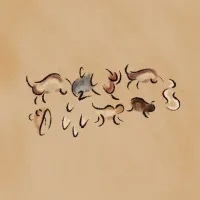
Aksӑhahhbu (ɐkt͡s*hɐhhbu), meaning the Language of the Steppe, is a hypothetical language based on cave paintings and ancient scripts, such as Proto-Sinaitic. It was used primarily by an obscure culture in North America that inhabited mammoth steppes. The language is dated somewhere before the Late Pleistocene-early Holocene extinction (13,000-11,000 BP). The language is nicknamed Ochregraph or Ochreglyph because ancient peoples used ochre as a material for painting. Ochreglyph is read from left to right, bottom to top. It uses VSO, but has a free word order.
BRUSHASKI
by Meesam Gari
HI. I am meesam gari from gilgit baltistan and am trying to make sounds combining russian and korean in korean cvc format . some of the difficult sounds are founds in russian and i like korean text . it derives to accept korean style of writing . looks aesthetics and exotic vibe is all i want for brushaski.
MY LANGUADE
by Theo Cognato Nunes
hue
Hinogo
by ButterScott
ΣΧΤΕΝÁ
by Juno
Recreation Of Esperanto
by Theo Cognato Nunes
Just Like Esperanto
English 2.0
by Theo Cognato Nunes
letters: a b d e f g h i j k l m n ñ o p r kw s ç t u v w x y z ~ dʒ numbers: c 0 1 2 4 5 6 7 8 9 ^
Vivora
by Sylvester Lucas
Kaya
by Apiwud J
Kastus
by Apiwud J
Maximos
by Maximos
easy
Ma'i
by Joe
Waffleian
by Waffle
Old Waffleian
by Waffle
Proto-Finnic
by Waffle
Estonian
by Waffle
Old Estonian
by Waffle
Edievian
by Ianis Pavel

Romandian
by Ramsal Black
Spelling isn't standardized across the entire language, rather Romandian splits into two main camps (with their own standardization). 1. - The official camp, uses the standardized alphabet, which includes the letters Š, SS, Ff, and V, the spelling is more standardized, and the words are pronounced as they are spelled. 2.- The dialectic camp. This is the camp spoken usually by the Romandian diaspora and speakers of Romandian Dialects. Rather than use Š, SS, V and Ff, they use Ş, Ç, and Ƒ. For the sake of diversity and proper representation (which is expected, since the split between Standard and Dialectic spelling is about even 40/60) i will use both spellings. Dialectic speakers also tend to use the standard spellings (with their own letters swapped) but tend to pronounce the language slightly differently. It's not enough to matter here however, because if a word is spelled with a Ç or Ş, the standard spelling is almost always the same, just with Š or Ss.