About
Conworld History
Hiberio is an East(!)-Semitic language spoken on the Iberian Peninsula and resembling modern Castilian Spanish both graphically and phonetically.
Its direct ancestor, a sister language to Akkadian, was spoken in the Western Mesopotamia. This language deviated from the Akkadian we know (and love) in that it e.g. had few archaic consonants that merged in Akkadian were still distinguished - the consequences of that are reflected in Hiberio. Like Akkadian, it too was profoundly influenced by Sumerian - which conwold-wise still has living descendants.
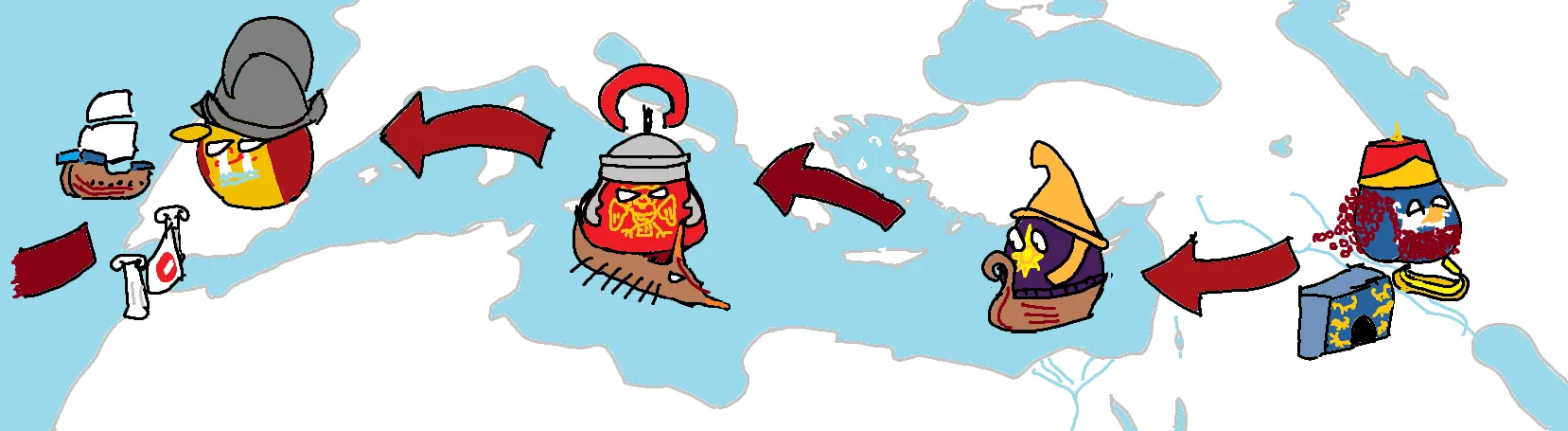
At around 18 century BCE the Empire of Mari that spoke this language has conquered the Levantine coast, putting its own ruling dynasties in its city-states. By the time of the Mari Empire fell two centuries thereafter, the region predominantly spoke its East Semitic Lixanum Maritim /liˈʃaː.num maˈriːtim/- Language of Mari .
Being confined to a narrow strip of fertile land between the desert and the sea, Akkadian-speaking "Phoenicians" of the conworld's Levantine coast had to compensate the lack of resources with maritime trade and expansion. The Bronze Age Collapse - even though it resulted in destruction of many of their cities and abandonment of the cuneiform script - ended up being a catalyzer of this process. Not only did the Sea People create a trading vacuum in the Mediterranean, they have also brought to the Levant their seafaring know-how that helped the "Phoenicians" fill this vacuum. Soon, the "Phoenicians" were creating numerous colonies, from the Black Sea via Mediterranean to as far as Ireland and Jutland. Those newly established polities spoke Lexanum Adnatim /liˈʃaː.num adˈnaː.tim/- the Common Tongue - now written in an alphabetic script.
By 300 BCE one of those city-states - the Republic and later Empire of Feria (Syracuse) on Sicily - subdued most of the Mediterranean under its control. However, it remained a thalassocracy - sea-centered, fiercely clinging to the shores at its countless ports, but largely disinterested in the interior. The official language of the Ferian Empire, a Mediterranean lingua franca of the era, becomes known as Lexanum - "The Language".
Iberian Peninsula was one of the places where Ferian influence seeped deeper inland, with Lexanum becoming the language of the local elites and then of much of the populace. Then, during the Migration Period that saw the dissolution of the Ferian Empire, Germanic and Sinitic nomads occupied the peninsula. Their successors would eventually switch to the local variant of Lexanum, but not before leaving substantial marks on both its vocabulary and phonetics. The collapse of the sea trade - new masters across the continent ruled from a horseback rather than shipdeck - caused Lexanum to evolve fast and in isolation from other emerging dialects, eventually drifting far enough to be recognized as a separate language - Hiberio.
As of today, Hibeiro is a dominant, but by far not single language spoken in Iberia and its many former colonies.
This story is, of course, direly incomplete - I still have very little understanding of the global history of my conworld.
Check out my other languages from the same conworld:
Vandalon - a Germanic Fenchlang, my first serious and most advanced project
Fou Tong - a Germanic language spoken in East Asia that sounds like Standard Chinese
Kyrsk - an Italic language spoken in Scandinavia that looks and sounds like Norwegian
Phracian - spoken on the both shores of the Bosphorus, it plays on the idea that Thracian and Phrygian were Baltic, and evolves Proto-Balto-Slavic into something resembling Modern Greek.
Coming soon:
Quїan - an Italic Ukraїne-Lang
Kulgarian - cyrillic-written Sinitic language spoken in the Balkans
Ilativian - a Hellenic language spoken in the Baltics, inspired by Latvian
IRL Inspirations
While an appearance of an East Semitic language such as Akkadian on the Iberian Peninsula may sound a bit of a stretch, it is worth remembering that Arabic, a language from a much further land, was spoken the by a large proportion of the population for 900 years, from the Moors landing in 711 to the final expulsion of Moriscos in 1609. Phoenician colonies existed on for hundreds of years before it was overtaken by the Romans, and so it is a good bet to say that, should Rome have lost Punic Wars, Phoenician could have become the official language there instead of Latin.
While, like Arabic, Phoenician was was a West-Semitic language, the Phoenician homeland was conquered by an Akkadian speaking empires several times, and Akkadian itself was used throughout the region as the language of official correspondence (with some local tweaks). Therefore it is not hard to imagine of former West-Semitic speakers of the Levantine coast switch to Akkadian rather than vice versa, before going onto the colonization spree.
The structure of the Ferian Republic/Empire is clearly inspired by Venice, but also Athenes-led Delian League and, of course, Carthage.
The Sinitic invaders mentioned in the Migration Period are inspired by the Huns, but also the fact that, to the best of my knowledge, the Iranic-speaking Alans reached spain with the Vandals and Visigoths. See more in Fou Tong and Kulgarian (upcoming).
Creation History
My wife got her second master degree in Philology of Ancient Mesopotamia - shortly, in short she can read Sumerian and Akkadian. While at it, she often used my analytic and googling capabilities to find cuneiforms and word-forms. In order to be more helpful, I decided to learn some Akkadian with her - which, with the use of Riemschneider's textbook, went surprisingly easy.
By the time we've finished the book, though, she was so fluent that my help wasn't needed any more.
I, on the other had, has been struggling to find an inspiration for another conlang. Having learned some Spanish earlier in life, I toyed with an idea of a Germanic Spanish, but after Vandalon and Fou Tong this idea didn't sound as exciting any more.
As we walked under the chilling rainshower on a dark evening of November 2023, talking about some rare forms in Akkadian (R-stem to be precise) and how nice if there were a language using them at full, it all just came together in my head: I need a new conlang, and I don't want to lose my proficiency in Spanish and Akkadian - so why not a Spanish-Akkadian conlang? That is when Iberio was born.
Hiberio is not an easy child. While I mostly use Proto-Italic → Latin → Spanish sound change to create Proto-Semitic/Akkadian → Lexanum → Hiberio for inspiration, a there are a lot to consonant clusters naturally occurring in Semitic languages that neither of the prototypes allows. the value of Proto-Semitic sounds that is all to often unclear, and I often retreat to guesswork. But while Hiberio does not grow as fast as most of my other languages, I like it very much, and hope that LingoCon becomes its new cozy home.