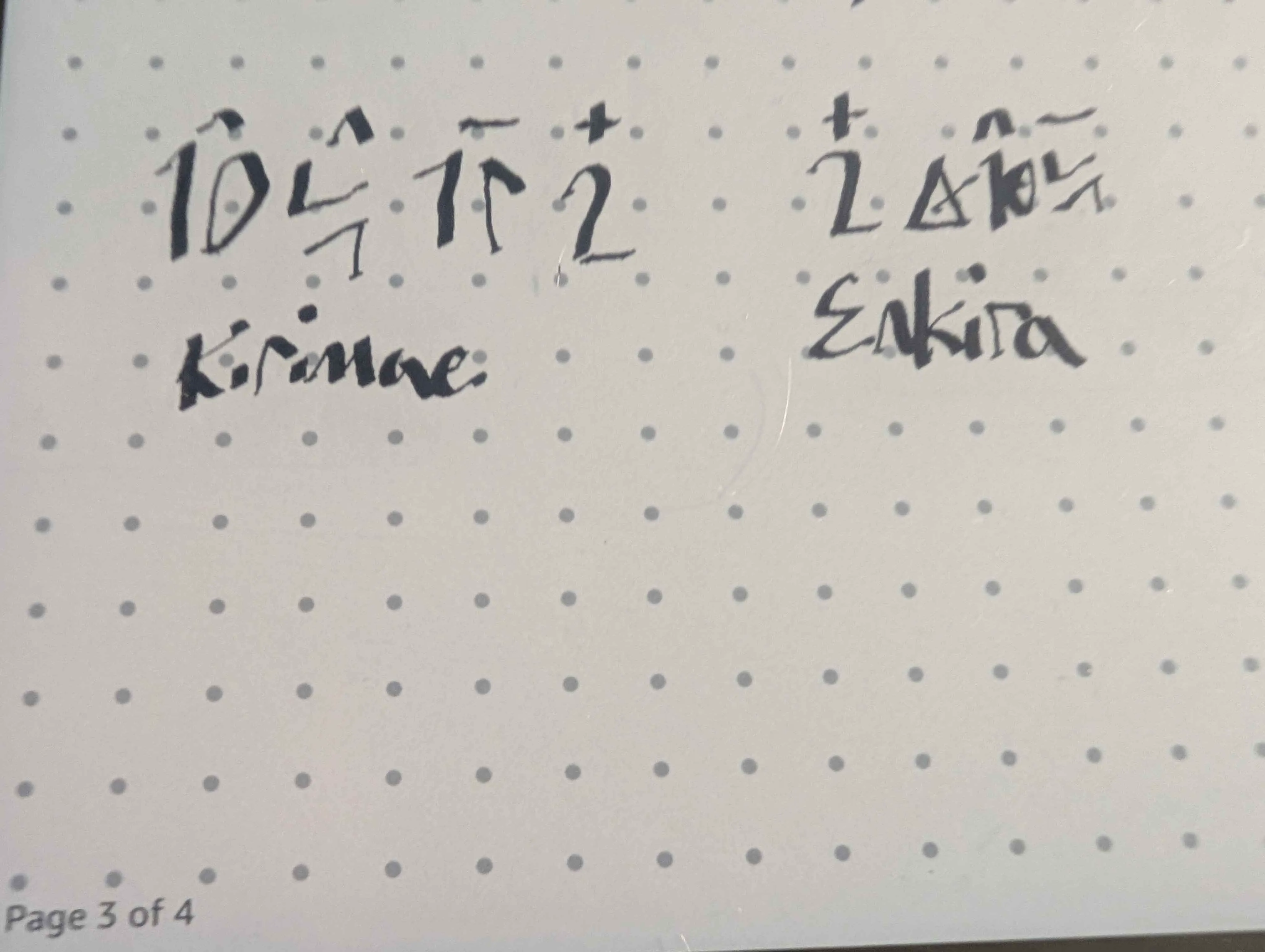
Kirimae Information
NO AI WAS USED IN THE MAKING OF THIS LANGUAGE!
Kirimae is a constructed language, designed for demons. Anyone can use, expand and modify it, provided they give credit to the original creator as C. B. Lone, Amastelo, nonbinaryStele or terminalPsyche. Kirimae is licensed under CC BY-SA 4.0 (Creative Commons Attribution-ShareAlike 4.0 International) This license does not apply to use in Web 3.0, NFTs or for real life bigotry of any kind. This license must be applied to all versions of Kirimae, even if the name changes.
Note on pronunciation: pronounce each vowel by itself. ! is a click, : is a glottal stop. Use modern Greek/Esperanto vowels. th indicates ð, while TH indicates θ. J should be pronounced as Y and any letter with a circumflex should be pronounced like its Esperanto counterpart. F is often pronounced by blowing through the lips, as in Japanese. The stress is on the penultimate sound, as in Esperanto and Polish.
Consonants usually modify the letter after it, unless it's clustered. This works for both repeated consnants and grouped consonants. Therefore, aka -> ah-kah, akka -> ahk-kah. ! and : are counted as consonants, so ur:a would be ur-()-ah. You can separate clicks or say the vowel as you click. The kind of click used is pressing the tongue against the top of your mouth slightly behind your mouth and lightly sucking in air as your toungue releases and hits the bottom of your mouth to make a loud click. You can also tsk if you can't do that, or use the substitution sound. For the glottal stop, it's the cut off in uh-oh, So ur by itself lasts a beat, ur: is half a beat and cut off by the back of your tongue.
Sound substitutions: Some demons lack lips and some humans can't do clicks/glottal stops. Here's the substitution scheme when not otherwise indicated:
f = !th
r (rounded) = !dr (rolled)
p = !t
m = !n
w = !z
v = !TH
: = ch (as in choose or chicken)
! = k (without verbalizing)
Prefixes for verbs determines the time or case. Use the first form for words that start with a vowel, the second for words that start with a consonant. As with honorifics, add asi to make the words for past, present and future.
Honorifics are used as relationals, such as speaking to a stranger, a friend, a clansman of the outer clan or of the inner clan, to a teacher, student, slave or ruler. Friend or -THa is polite when you aren't sure. Not adding any is understood to address people of varying status. To use the following as nouns, add as- or asi-. For humans, it's asikazi, to differentiate from fauna/beasts.
Honorifics can be used to be formal on verbs, or to indicate a specific subject by status. Usually, they're only added to pronouns. You can also add it to nouns as desired.
-zia can be used insultingly, but isn't insulting in and of itself. Like calling someone a beast in battle or bed is considered praise, or at least a way to call someone aggressive or a go-getter.
Indicators for numbers: (places with zero are skipped, except after the decimal point.) That which indicates the quality/form of the number (ordinal, fractional, percent, estimations) come last.
Word order is SVO. However, descriptors come after the word, as in French. Quality order is the same as English. So [object]i [quality].
The direct subject and emphasis markers are used before the subject. The linker, I can be used by itself to link words for clarity.
With any prefix or suffix, add a glottal stop (:) if necessary.
An -n final is pronounced similar to humming, but voicing the n consonant while not letting air escape, as in Japanese. They’re artifact words from older languages.
You can use asi- on quality diminisher/intensifiers and add -e/-a/-u at the end to indicate different things, like someone of importance (asala), someone mediocre (asizoma), someone who’s a nobody (asizotu), etc. Adding them to a pronoun can indicate how high on their own hype someone is (ureŝTHia) or how humble/scared someone is. (eŝzi ŝurazozeki pomikuna asizozi:a! (I[slave] implore/beg you to forgive this humble self!)
A note on how to use -e and -a: You can use -e or -:e and -a or -:a to ensure clarity on any word. Usually, -a is something that is concrete, specific, animate or something that physically exists. -e refers to metaphorical things/actions, spiritual, generic, inanimate things, a figure of speech or indicating something that is only an idea or ideal. Good is an idea/ideal, so dareme instead of darema. Jewels do exist, so it is kira, not kire. You can, however, render it kire, when you want to specify generic jewelry, rather than a specific gem or gem type. Keep in mind that you should generally replace, not append.
Kirimae means ‘jewel language’ or ‘language of trusted wealth.’ Jewels are strongly associated with wealth in demon culture, as it commonly has in human culture. Carrying jewelry shows that you’re trusted to carry that wealth.
Kirimae doesn’t differentiate between adverbs and adjectives. They are both considered qualities and are appended post-word to modify it. If it applies to both the words that surround it, append -i or -:i to the end. Use the adverb/adjective markers if needed.
When speaking of consent, ramkaotu is the state of continual consent and kaohetu refers to the act of consenting in the present moment that may be taken back.
Honorifics can be used to indicate friendliness, hostility, humility or ego. -Tha (friend) is considered neutrally polite. No honorific towards a single being is considered slightly rude or uncouth, similar to people using the word ain’t in formal contexts. It shows a lack of consideration. Though someone who is obviously new to the language is excused if they forget honorifics.
Kirimae has addressee-agreement. Honorifics can be appended to verbs to hint at addressee, or to make rudeness or politeness very clear. If it’s used, the pronoun may be dropped. If both are used, it’s for emphasis. It is only to indicate the addressee, not the subject. A subject gets its own honorific if it’s a living being.
In legal documents, speeches and anything without a precise intended single addressee, -ka (stranger) or -THa (friend) can be used without offense. Other terms can be used for buttering up, insulting or showing off ones’ ego.
The use of -sia (teacher) can also be applied to professionals and elders who are wise. -ri can be extended to a parent, a parent’s other partner or someone the speaker views as a parent. -ria can be extended to a beloved child, or children in general (or rudely to insinuate someone’s being immature.)