The History of Lerrebeth
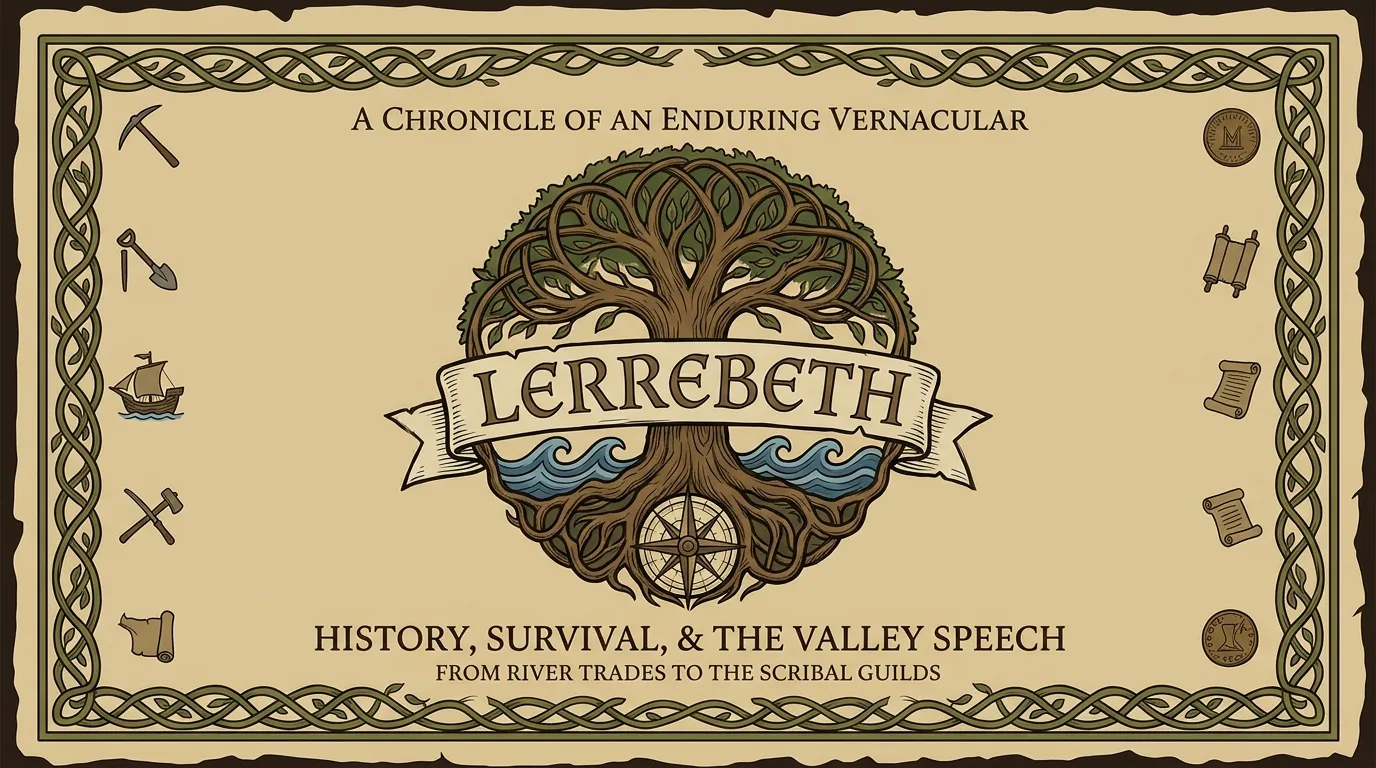
The history of Lerrebeth is not the story of a sudden invention, but of a quiet, stubborn survival across centuries of regional isolation, trade, and sociopolitical shift. Long before it was recorded in systematic texts, Lerrebeth existed as a cluster of unwritten river-basin dialects spoken by agricultural communities and coastal traders along the lower Ler valley.
Early Period: The Valley Vernacular and Trade Pidginization
The earliest recognizable stratum of Lerrebeth emerged during a period of heavy maritime commerce between inland agrarian clans and neighboring coastal states. Lacking a centralized administrative power, early speakers relied on a pragmatic, highly concrete vocabulary focused on topography, trade goods, seasonal flooding, and immediate kinship ties.
During this era, Lerrebeth was heavily influenced by external prestige tongues. Foreign merchants brought administrative terms and technical jargon into the river ports, but these loanwords were gradually eroded and re-shaped by native speech habits—a process that smoothed complex foreign phonology into Lerrebeth’s distinct vocal cadence. Early texts from neighboring regions refer to the tongue dismissively as the speech of the lower reaches, noting its lack of formal court registers but acknowledging its utility as a neutral language of commerce.
Middle Period: Fragmented Preservation and Scribal Standardization
The turning point for the survival of Lerrebeth occurred during the regional collapse of the Northern Hegemony. As centralized imperial rule dissolved into local warlordism, formal monastic orders and independent scribal guilds retreated to the isolated sanctuaries of the Ler valley.
Finding the local vernacular spoken by the surrounding populace, these monastic scribes began utilizing Lerrebeth for ledger-keeping, agricultural records, and local chronicles. This era marked a profound transition:
Lexical Consolidation: Scribes systematically gathered regional variations of everyday words, choosing specific dialectal forms for official records while allowing secondary forms to drift into archaisms or local slang.
The Pronominal Reform: As legal contracts and land deeds became more frequent, early ambiguity around personal and property reference forced scribes to formalize a rigorous, universally understood set of pronouns and determiners.
Etymological Drift: Many compound words originating from ancient trade jargon lost their original roots entirely, fusing into opaque, single-stem nouns and verbs through centuries of oral repetition.
Late Era: Modern Standardization and Cultural Renaissance
By the onset of early industrialization, Lerrebeth was no longer a scattered collection of rural dialects, but a resilient regional language with a deeply rooted scribal heritage. The rise of printing presses in the valley cities forced a final wave of unification. Broadsheets, local histories, and secular poetry codified the language's modern forms, cementing the shift from purely functional trade talk to a full medium of literary and civic identity.
Today, Lerrebeth carries the visible scars and layers of its long journey. Archaic trade words survive as modern formal expressions, old monastic legal terms linger in everyday etiquette, and forgotten river-dialects still echo in its regional idioms—a living archive of a language that adapted, endured, and carved out its own permanent space through sheer historical momentum.